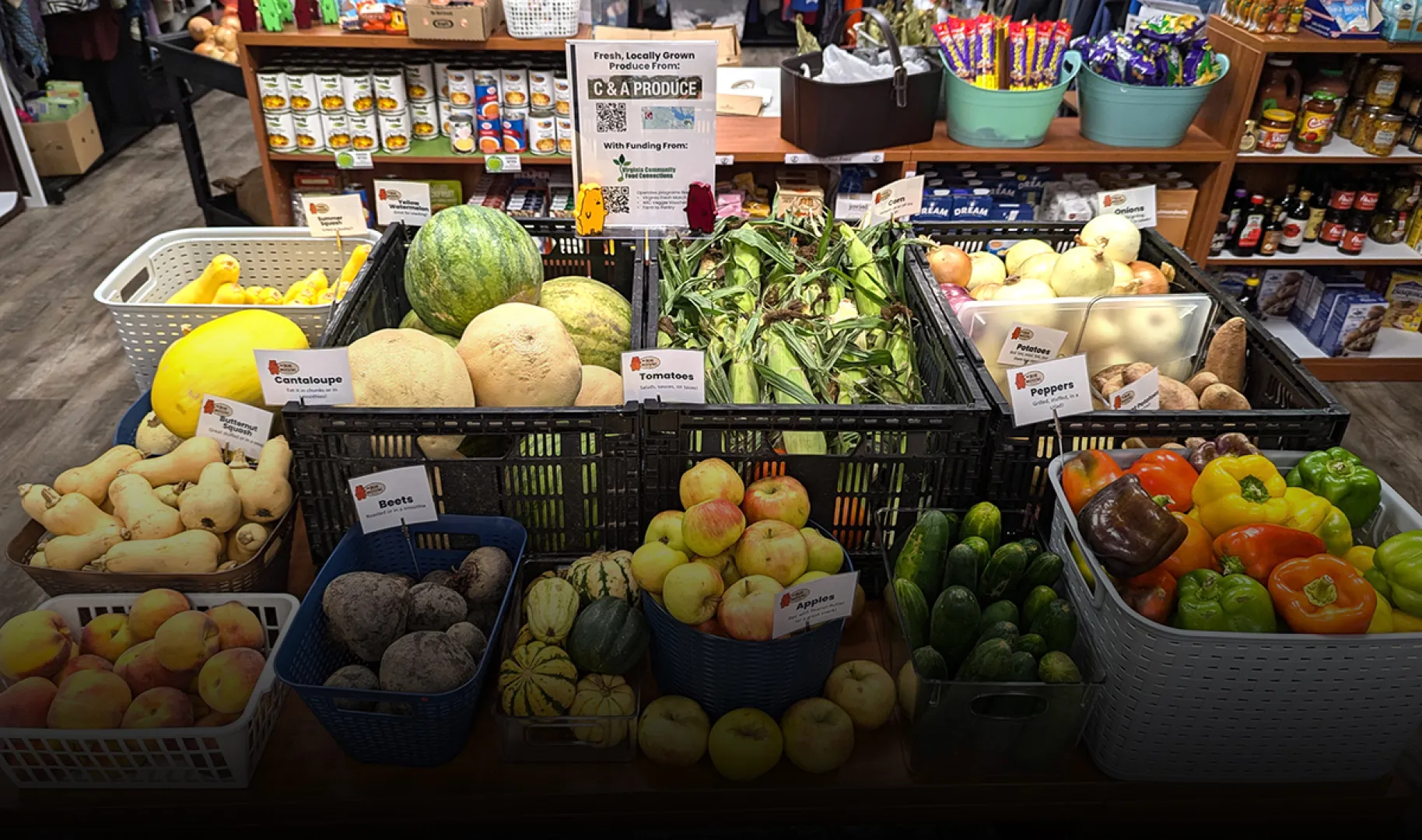
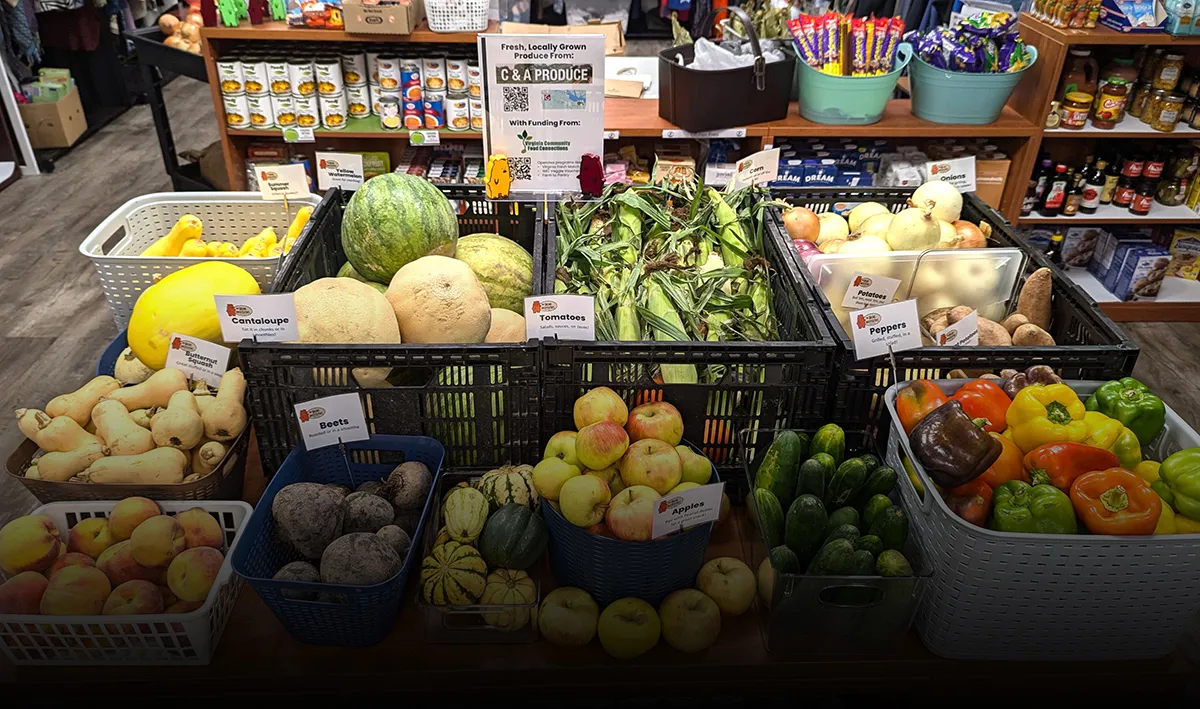

Thursdays come with a dress code: closed-toe shoes and Germanna T-shirts with jeans or pants you don’t mind getting dirty. Stocking the college’s food pantry—open four hours a day twice a week—is a multi-stop race against the clock to turn last-chance food and local fields into a small but mighty marketplace.
Minutes before the pantry’s 2 p.m. opening, a line has already begun to form. There is a mother with a small, smiling child in a stroller. A 20-something, a 60-something. The earliest shoppers are regulars that Kevin Mielnik and Lindsey Epperson, Germanna’s food pantry specialists, greet by first name, students who know the drill and bring their own grocery totes. They will have first pick of today’s freshly stocked fridges and freezers and shelves: two frozen meats and as many staples and as much produce as two bags will hold.
It’s food to help feed themselves and their families. But it’s more than that. It’s what Epperson calls “elasticity.” In a world of burgeoning rent and electric bills and gas prices, of dwindling SNAP benefits and narrowing eligibility to Medicaid, these shoppers are looking for a way to stretch budgets that have been bent to nearly breaking.
For many, the food pantry provides a vital bridge.
“Food insecurity can be a huge roadblock to education,” Epperson says. “If you can’t afford to feed your family, if you can’t afford to feed yourself, your mind is focused on other things besides your education.”
The food pantry helps clear that roadblock by fundamentally changing the math of survival. The frozen meats, pasta, and fresh produce students take home are items they no longer have to purchase. That can amount to hundreds of dollars in savings each month—and potentially thousands of dollars in a semester. That’s money pulled out of their grocery carts and handed back to them, freeing up vital cash for rent, an electric bill, an emergency car repair.
But building that safety net takes work. It takes creativity, community, and connection.
And every Thursday, it takes a sprint.
Racing the clock
It’s just after 9 a.m. Mielnik and Epperson are taking their last swigs of coffee from insulated mugs inside Germanna’s food pantry.
Today is retail rescue, and they have a new partner, which means they’ll have two grocery store stops instead of one, followed by a visit to a local farm. In between, they’ll sort through donations from the grocery stores, checking dates, keeping what looks good and setting what’s not aside for a local composting partner.
Before Mielnik and Epperson came aboard three years ago as Germanna’s first employees whose jobs are dedicated entirely to food pantry operations, the role fell to college counselors and other staff who balanced other duties.
“Germanna invested in the pantry by investing in us,” Mielnik says. “There was a need, and the need was growing.”
At the time, the pantry—officially called Bear Necessities in a nod to Germanna’s grizzly mascot—moved from a closet in the Workforce Building to a larger space near the Student Lounge, prime real estate in the V. Earl Dickinson Building. It also came with much-needed storage space.
More than 100 shoppers visit the pantry and two others at the Locust Grove Campus and Stafford County Center each week.
“Lindsey and I always say we are standing on the shoulders of the people who came before us,” Mielnik says. “We inherited a really nice food pantry. We were charged with taking it to the next level.”
The Fredericksburg Regional Food Bank has been a vital, long-time partner in keeping the shelves stocked, investing in the space through the statewide Healthy Pantry Initiative, a grant program focused on healthy food, shopper choice, and community connections. At Germanna, the evidence is in the numbers: 37% of food is fresh produce—a rarity among food pantries, which often rely mostly on shelf-stable goods.
As student demand grew, Germanna needed to build on that foundation by tapping into additional streams of food. That included Farm to Neighbor, a regional nonprofit that purchases produce from local farmers on the pantry’s behalf—an arrangement that benefits both.
Grants have also helped pay for pantry infrastructure and given the team the flexibility to buy food directly, allowing them to stock culturally relevant items that aren’t often donated.
Another source: Food Lion in Spotsylvania County. It is Mielnik and Epperson’s first stop on Thursday morning, a straight shot down Patriot Highway in a Germanna-branded Ford Econoline passenger van. Inside the grocery store, they divide and conquer, each grabbing a cart and heading in opposite directions: Epperson stops at the bakery first while Mielnik visits the meat department for premium items before they hit the landfill.
Today’s haul includes jugs of cider, heads of last-chance lettuce, platters and packages of cut fruit, bags of baby carrots, a spaghetti squash, a lone dragon fruit packed into brimming Dole banana boxes.
Epperson checks the temperature of refrigerated items. Once everything is loaded into the van, she and Mielnik head back to Germanna, where they weigh, sort, save, discard, document, and store. It’s an art and a science, an exercise in logistics and upper-body strength refined through weeks and months of repetition—a cart and a dolly at the ready, two rubber doorstops duct-taped together to withstand a heavy-duty door.
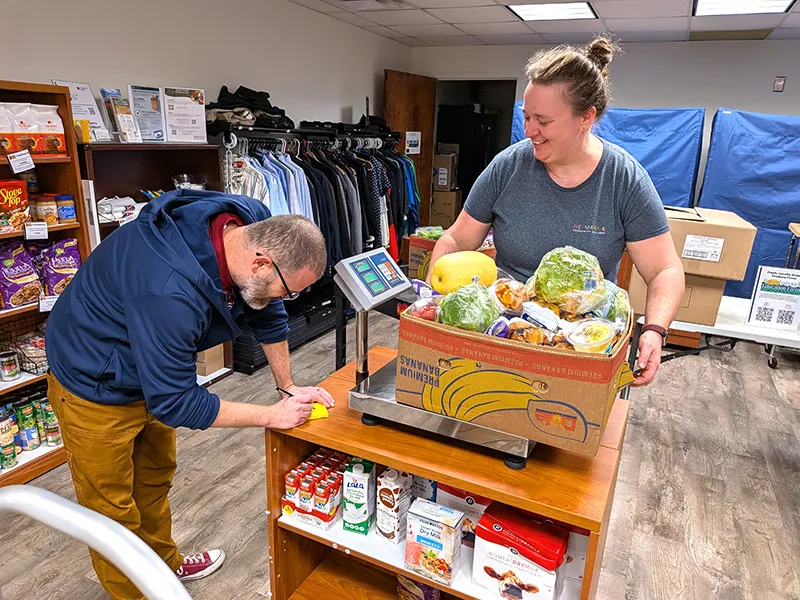
“This is food that would have all gone to waste,” Epperson says. “And there is a lot of really good food in it.”
They check the time. Still on track.
But with the next grocery store stop a relative unknown—they have only a contact name and directions to come to a door near a ramp around back—they’ll need to get going.
In stride
Neither Epperson nor Mielnik set out to work in food insecurity, but they arrived at Germanna uniquely wired for the work.
“I graduated college at the height of the Great Recession,” Mielnik says. “What I wanted to go into—there weren’t that many opportunities.”
So he pieced together jobs to earn a living and started volunteering at a food bank. This ultimately led to a full-time job at a food bank in San Diego, where he lived with his wife, an active-duty sailor.
Epperson had spent much of her adult life living overseas running youth and young adult programs in East Africa and later, Alaska. Her work focused on bridging culture gaps, building community, and finding—and stretching—limited resources.
It was an ideal match of complementary skill sets and personalities.
Together, they focus on meeting students where they are—showing newcomers how to stretch their groceries, sharing recipes based on what’s available that week, and sometimes connecting them to other community resources. The pantry can be the first stop—and the first step—toward asking for help.
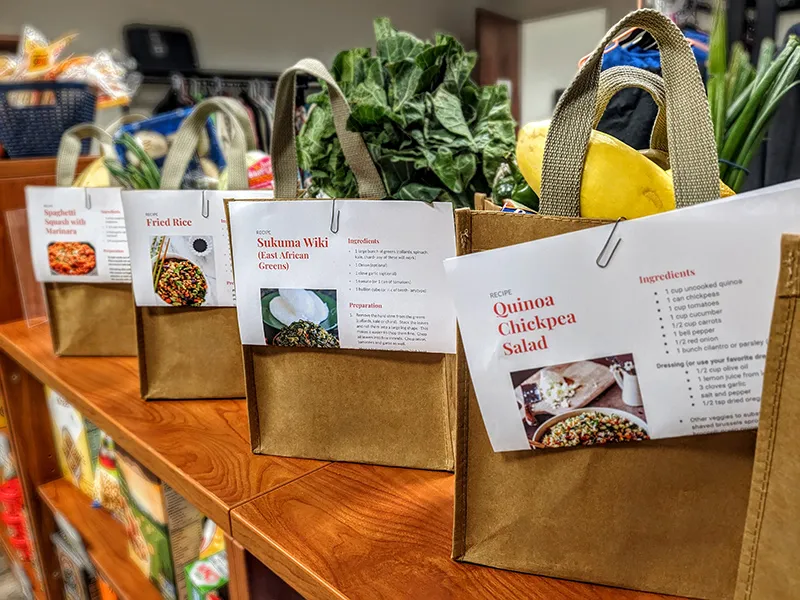
“We can’t always change the situation, but we can at least impact one area, and that’s immediate access to food,” Epperson says.
By mid-morning, they are back on the road, Mielnik behind the wheel and Epperson giving directions. The grocery stop takes a little longer than expected; it does not yet have the practiced rhythm of the Food Lion run, but the brimming cart Mielnik pushes down the ramp at the back of the store will go a long way toward stocking the Germanna pantry.
By the time they return to campus, it’s past 11 a.m.—less than three hours to opening. Epperson will stay behind to weigh and sort and prep while Mielnik heads to the third and final—and arguably favorite—stop: the Rappahannock Education Farm.
Home stretch
Four years ago, Rich Larochelle, a longtime community organizer, learned that area pantries faced a shortage of fresh produce—about 200,000 pounds every year.
By March 2023, he and an eight-person board incorporated the Rappahannock Education Farm as a nonprofit; later that year, it closed on an 11.5-acre permanent home in Stafford County with the sole purpose of growing and donating produce to local food pantries.
About 40,000 people in Fredericksburg and its surrounding counties face food insecurity—not knowing whether they’ll have enough food to feed themselves or their family or having to decide between buying food and paying for other necessities.
Nationwide, food insecurity impacts about 13% of the population, yet for college students—particularly community college students—it’s far higher.
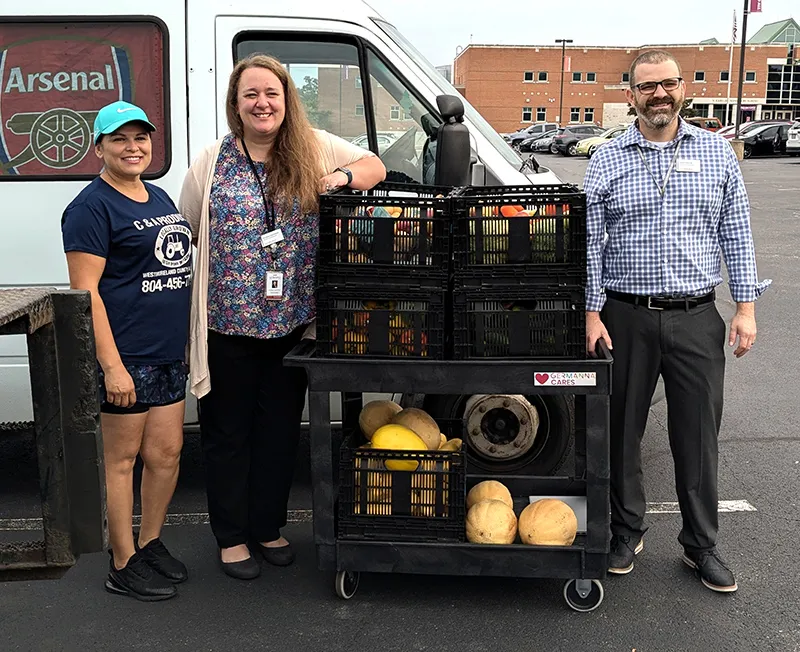
Larochelle is there to greet Mielnik when he pulls up to the farm, tires crunching over the gravel drive. Six large crates of produce are waiting: cabbage, green peppers, two kinds of kale, plus a box of sweet potatoes and a bag of hot peppers, much of it picked that very morning. Once it’s loaded, Larochelle walks over to a large whiteboard on the side of a barn and updates the number of pounds the farm has donated so far in 2026: 98,224.
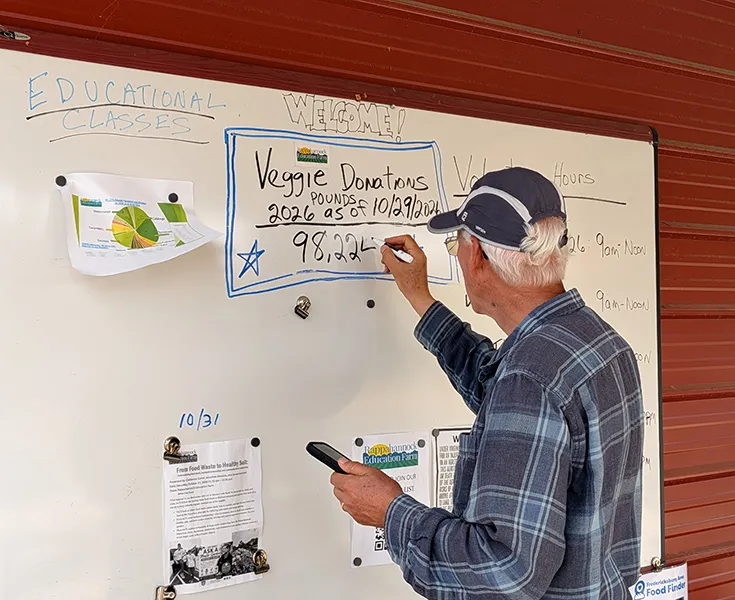
He hands Mielnik a pair of scissors and rubber bands; basil is growing knee-high along a fence, and Mielnik should cut all he wants. The sky overhead is the color of a cornflower, that uniquely autumn shade of blue against which fall colors seem to blaze. Frost will be coming, if not this week, then the one after, and it will take the herbs and the thicket of wildflowers with them.
Mielnik takes a boxful of basil for the food pantry. He checks his watch. He has about 10 minutes to join Larochelle for a stroll around the farm, where next year’s harvests are already going in. The sundrenched fields are cloaked in quiet, except for a flurry of honeybee activity. Local apiarists have installed hives to support pollination, part of a sustainability effort. They stop at the high-tunnel greenhouse, installed to extend its growing season. The farm, it seems, has thought of everything.
Larochelle, conscious of the time, ends the tour. By the time Mielnik pulls into campus a half hour later, Epperson and a work study student are waiting outside with the cart and the dolly.
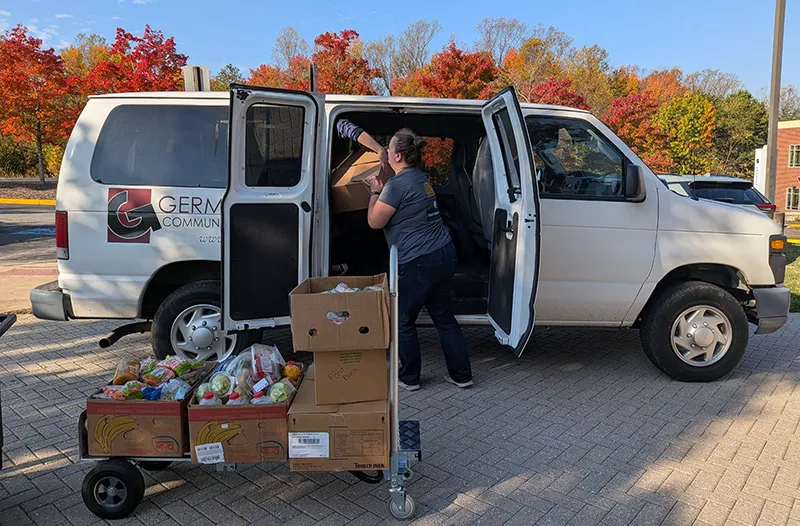
It’s 10 minutes to 2.
They’ll finish with a couple of minutes to spare, and when they open the doors, the pantry shelves are well-stocked. Produce is the centerpiece; the marketplace is full of the sharp, earthy smell of vegetables not long out of the dirt or off the vine.
The sprint is over, even as the students’ stories are still unfolding. For many, it is a season, a stopgap, a bridge to a new beginning, to graduation, a better life.
And Mielnik and Epperson are right there with them.