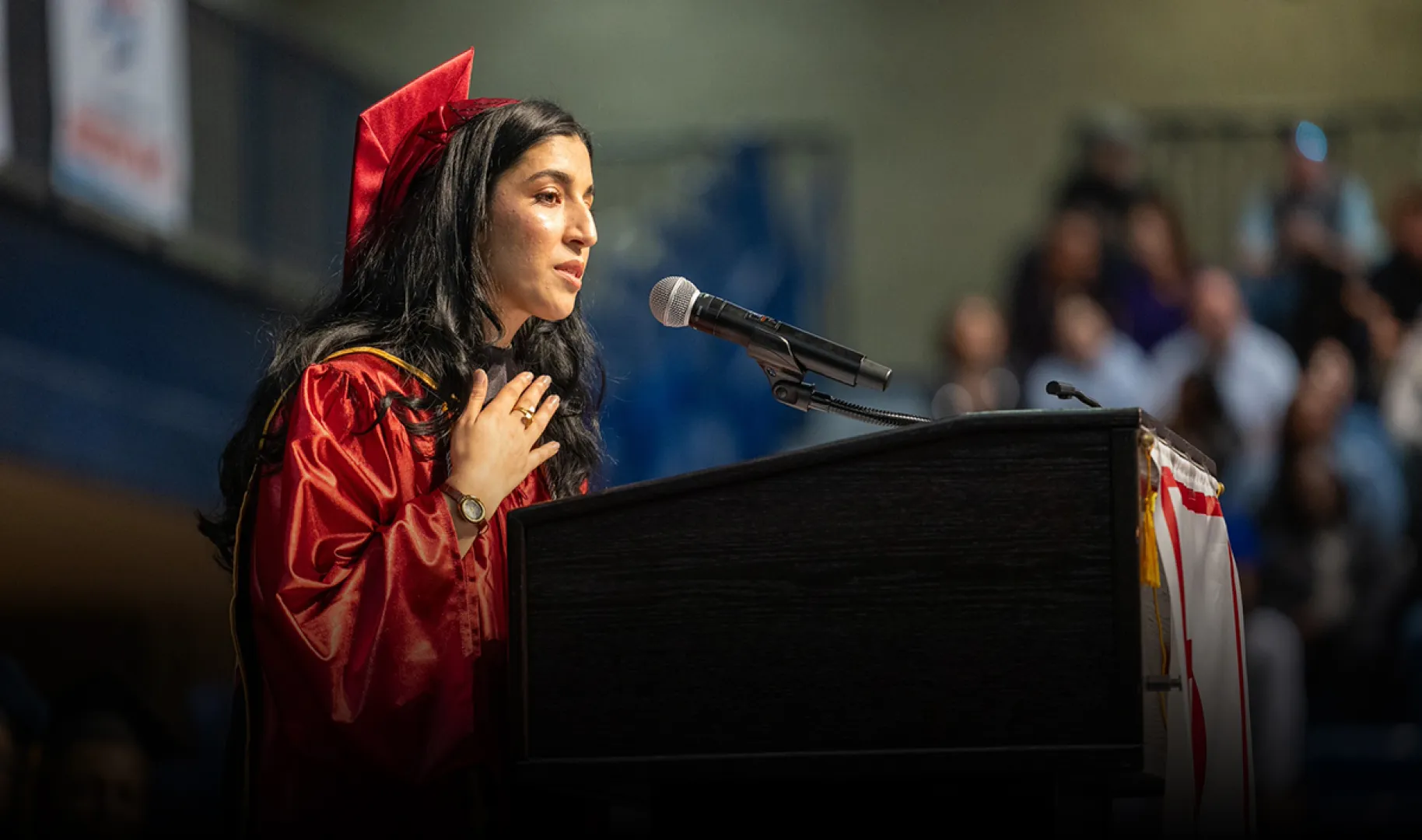
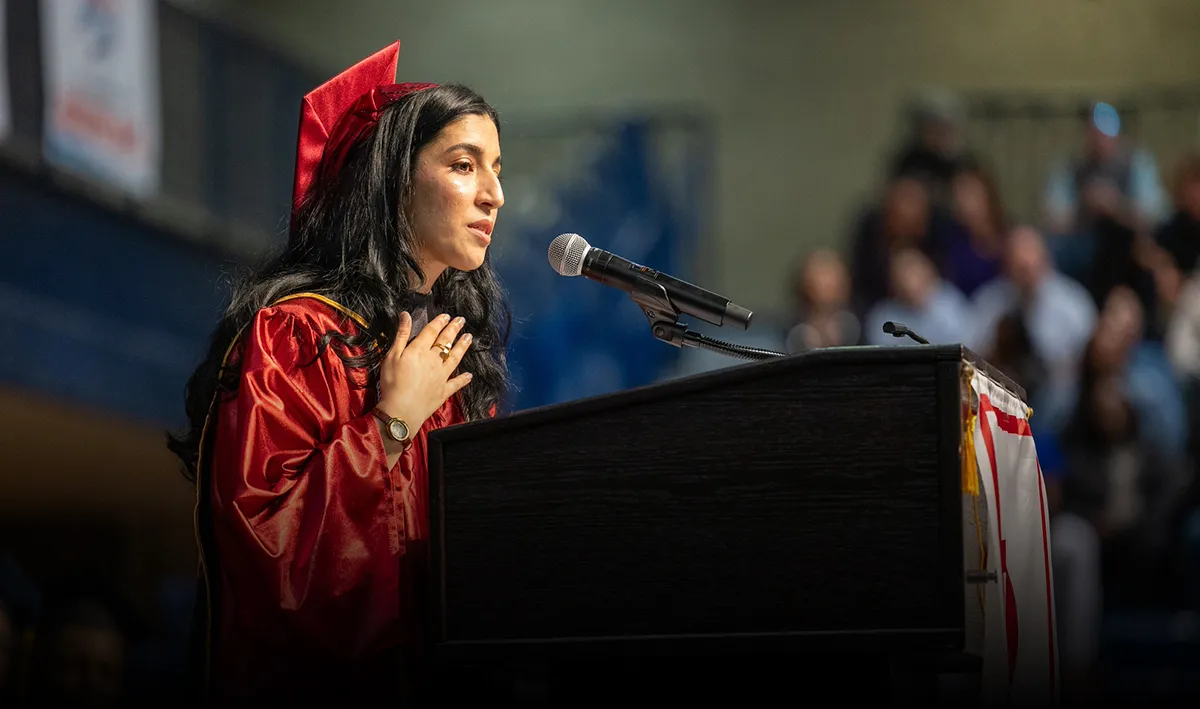

Something did not look right at her village school.
Nine-year-old Lima Waziri knew the building as well as she knew anything—it was as familiar as her own home.
A barn converted into classrooms, the building was the first school for girls her Afghan village had ever known.
Now, as she walked toward that beloved place after summer break, something was wrong. The building had turned black.
Waziri ran toward it.
What happened? she shouted.
The Taliban burned down the school!
Nearly everything was lost: books, school bags, supplies. The fire had consumed something else, too: the sense that her village—and the girls who lived there—might finally have a different future.
She would never forget that day.
Waziri did what she had learned to do whenever something was outside her control. The Taliban could destroy her school and everything in it. But they could not change her mind about what came next.
She would get an education. No matter what it cost her.
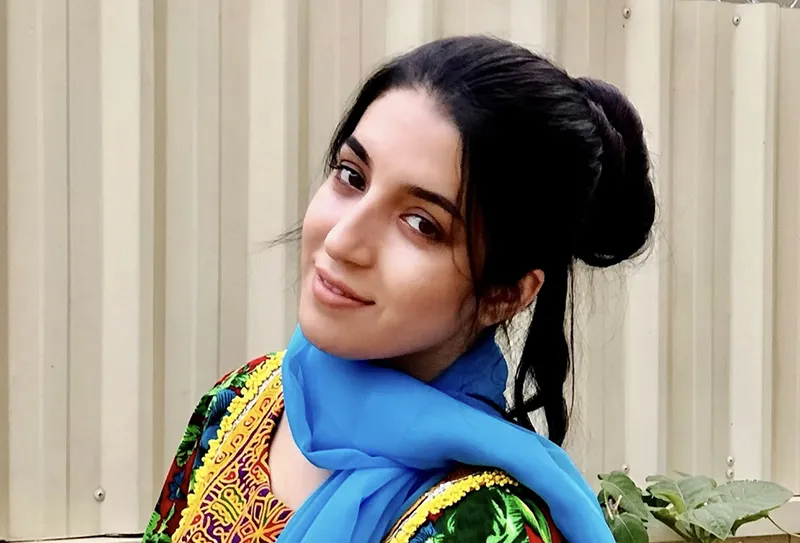
At war
Waziri did not know life without war.
She knew the sound of bombs. She knew that every day carried the risk of injury or death. That people were here one minute and gone the next. That buildings crumbled and schools burned.
Years later, when Waziri was a young adult, when the Taliban seized control of her country and girls and women lost access to education, she and her family would leave Afghanistan. They would settle in the United States, where Waziri would find her way to Germanna Community College, a place she could not have comprehended as a girl. And the people she met would call her story extraordinary.
But Waziri knew it only as her life.
She was a few months old when hijackers steered planes toward New York and Washington. Soon after, U.S. troops arrived in Afghanistan.
Waziri had been born in a village in Wardak province, outside Afghanistan’s capital city of Kabul, to a family of farmers. She spent her earliest years with her mother and grandparents and siblings.
Her father worked for USAID, a job that helped provide for the family but also put them at perpetual risk. Extremist factions actively targeted and threatened Afghans who worked with American or coalition forces. Her father kept distance between himself and his family to protect them, but fear of retaliation cast a long shadow over their lives.
Beneath it all, ordinary life carried on—and for the first time in decades, women and girls could receive an education. Thousands of schools had opened in the aftermath of the U.S.-led invasion in Afghanistan, including, for the first time, in Waziri’s village.
She was not, she recalled, an easy child. “I was really strong headed. My mom thought if she sent me to school with my older sister that it would be a chance for her to have a break from our arguments and always having an answer ready.”
The school had no formal curriculum, but within the walls of a converted barn Waziri learned to read and recite poetry and tell stories.
“I realized I was a star in that school. I couldn’t wait every morning to wake up and go to that school and be celebrated. I don’t think my behavior was appreciated at home, because I was always giving my family a hard time. At school, I was a different person.”
And then one day it was taken away.
‘The thing I wanted’
The fire destroyed the school. It did not stop Waziri from going.
The principal moved everything that was salvageable to her yard, and Waziri was among those who returned, sitting in a circle under the trees with classmates.
But for many families, the risk was too great.
Across Afghanistan in late 2005 and early 2006, attacks against schools, teachers, and students were rising. Human Rights Watch recorded hundreds of attacks during that time and dozens of schools burned or partially burned. In 2008, the Taliban attacked more than a dozen school girls and teachers with acid.
“My family really couldn’t prevent me from going. School was my whole life. I told them, ‘I’m going. I don’t care.’ Even if I died, this was the thing I wanted.”
Waziri promised to be home by four each day, when the bombings and explosions began, when her mother lined them up in the bathroom for their safety.
Beneath the trees that had become their classroom, she and her friends practiced what they would say to Taliban fighters should they threaten their lives. She would tell them that education was not a sin. That it was what she deserved as a human being.
The principal was willing to say the same.
“She was this courageous woman. I haven’t seen an example of that for the rest of my life. She would stand up. She would say, ‘Your bullets will go through me first if you touch my school or students again.’”
Then they began threatening her family. Three years after the fire, the village school officially closed.
Some distance away, in the capital city of Kabul where her father lived, schools for girls were still operating.
Waziri began plotting how to get there.
Running out of time
Every time her father called home, Waziri begged him to move them to Kabul.
I’ll study day and night, she pleaded. I’ll do anything if you move us to the city where schools are still protected.
“We had this conversation for months and months. Finally, my dad decided to move us to the city,” she said.
Waziri enrolled in school.
“It was throwing someone in sixth grade without any formal education.”
She had no choice but to catch up. She studied from morning until night, often sleeping just three or four hours.
In 2016, she graduated as valedictorian.
That fall, she entered Kabul University to study law. She had imagined college as a place where she could finally question the systems that had shaped her life.
“By my second year, I realized that system was not ready for change.”
Waziri began reading philosophy, religion, literature, and history in her free time.
“When I got to my third year, I didn’t know what to do with my life. I was taking a class in international public law. There was one small chapter on space law. As I went through it, I thought, ‘This is what I want to do.’ Space has no borders. It belongs to all of us. It belongs to humanity. I didn’t want to be defined by religion, by a political party.”
She approached her professor and announced that she would write her thesis on international public law.
We have no resources for that, he told her.
Give me the summer. I’m going to find all the resources I need.
It was 2021. She did not know it yet, but she—and Afghanistan—were running out of time.
The U.S. was preparing to withdraw. The Taliban was advancing across the country.
On the morning of August 15, Waziri headed to school.
By nightfall, Kabul had fallen to the Taliban.
Starting over
Although the Taliban had promised “amnesty” to Afghans who had served in roles supporting the former government, reprisals began almost immediately.
By September 2021, girls ages 13 and older were banned from school; women could not teach or attend Kabul University.
“Those were the darkest, darkest days,” Waziri recalled. “There was just fear going through every single cell in our bodies.”
She lost herself in reading the dozens of books from the library she had accumulated since 2018 with money from tutoring. She taught herself to play chess. And she shared her books with family.
“Education was the one thing that could change the trajectory of these people. When they read these books, they would tell me they finally felt like they had wings to fly.”
Her male cousins who had never received an education began attending school. “My dad became a bookworm after that. He read books from my library all the time.”
He had never treated Waziri and her sisters any differently because they were girls. He had never limited them. He decided the only way the family would have a future was to leave Afghanistan.
“I had three younger sisters. They could not get an education, which was such a simple, common thing for us growing up. He said he was ready to leave everything he had built at that point.”
Getting out of the country would be another ordeal. The U.S. embassy had closed. But in July 2022, the family arrived in the U.S., settling first in Maryland. Waziri could not speak English. She did not yet know the culture.
It didn’t matter. She enrolled in the Community College of Baltimore City, where she took courses in legal studies and awaited verification of her official transcripts from Kabul University in the hopes of finishing her bachelor’s degree.
“I went on with my life. Six months passed. They finally told me they could not verify my transcripts. I was female, and education had already been banned for women. I don’t know if I cried. I don’t think I did.”
Waziri considered entering the workforce full-time.
“When you leave your country and family and everything and go to a country where you don’t even speak the language and the whole reason is education, it is almost unethical to say you will not get an education.”
She would have to start over—this time with a new major and a new school.
It was called Germanna Community College.
Wings to fly
It would have been easy to grow frustrated, to see it as more time lost. But Waziri did not look at it that way.
She had learned how to navigate the American education system. And with every day that had passed, she became more certain that she did not want to be a lawyer. She wanted to work in the space industry.
But doing what, exactly?
Waziri was exceptionally good at math. A professor suggested aerospace engineering. It seemed impossible at first. No one in her family was an engineer. But, she wondered, if other people could do it, why couldn’t she?
“Whatever it takes, I will do it. If I fail, I will try again. If I fail again, I will try again.”
She entered Germanna in February 2024 at age 21. She would watch students in the engineering lab and think she had made a mistake. That she would never be able to learn this.
Then she met Germanna’s professors.
“The people were amazing. I had the opportunity of a lifetime to be in class with these professors. They gave me the confidence that I could go forward.”
There was Harry Schoeller, the chair of the Engineering Department, and engineering professors Kenneth Jaskowiak and Rodney Estwick. There was Mirla Fatea, a physics professor.
It was not easy. There were days when she studied from 5 a.m. until 7 p.m. She kept going.
“If you do the work,” she said, “you can do it.”
Less than two years after she began, Waziri graduated with an associate degree in aerospace and mechanical engineering and a certificate in computer-aided design.
Then, something unexpected: The University of Virginia offered her a full scholarship to complete her bachelor’s degree. On the advice of her beloved Germanna professors, she accepted.
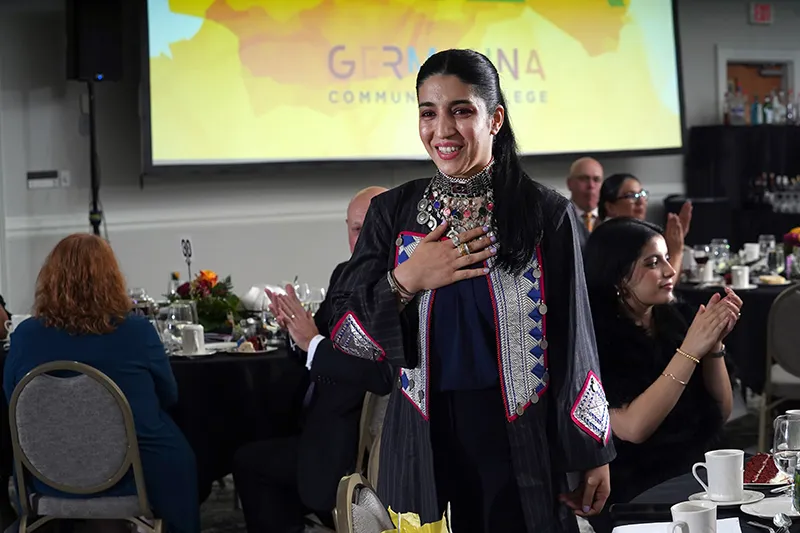
“When I wake up every day and walk the grounds of the campus, I think, oh my gosh this is the life I was dreaming of. This is the life I was wishing for myself and worked for. I have to enjoy every single moment of it.”
She thinks about the people who helped her get there. And she thinks about the people she left behind.
“When you go through a trauma like war, it’s part of your life. It’s another day. There would be an explosion in front of us. My dress would be all torn up. There would be metal in my hair. We would lose students. In a day or two, you would go back to school,” she said.
“Germanna and all these opportunities gave me a chance to think about this. This was not normal. I’m OK with my journey. It allowed me to be more grateful—to see the value of life here. I owe so much to this country, to Germanna, to my second family.”
Waziri plans to pursue a doctorate degree in aerospace engineering and eventually work for NASA and become an astronaut.
There is another dream she carries with her.
Some day, she would like to return to Afghanistan. She doesn’t know when or how. But she would like to make her way back to her village, to the place where she once ran toward a school destroyed by fire. A place she loved. A place she would have given anything to return to—and did.
Someday, she would like to return to Afghanistan.
She wants to build a school there.
She wants to give children—boys and girls—wings to fly.