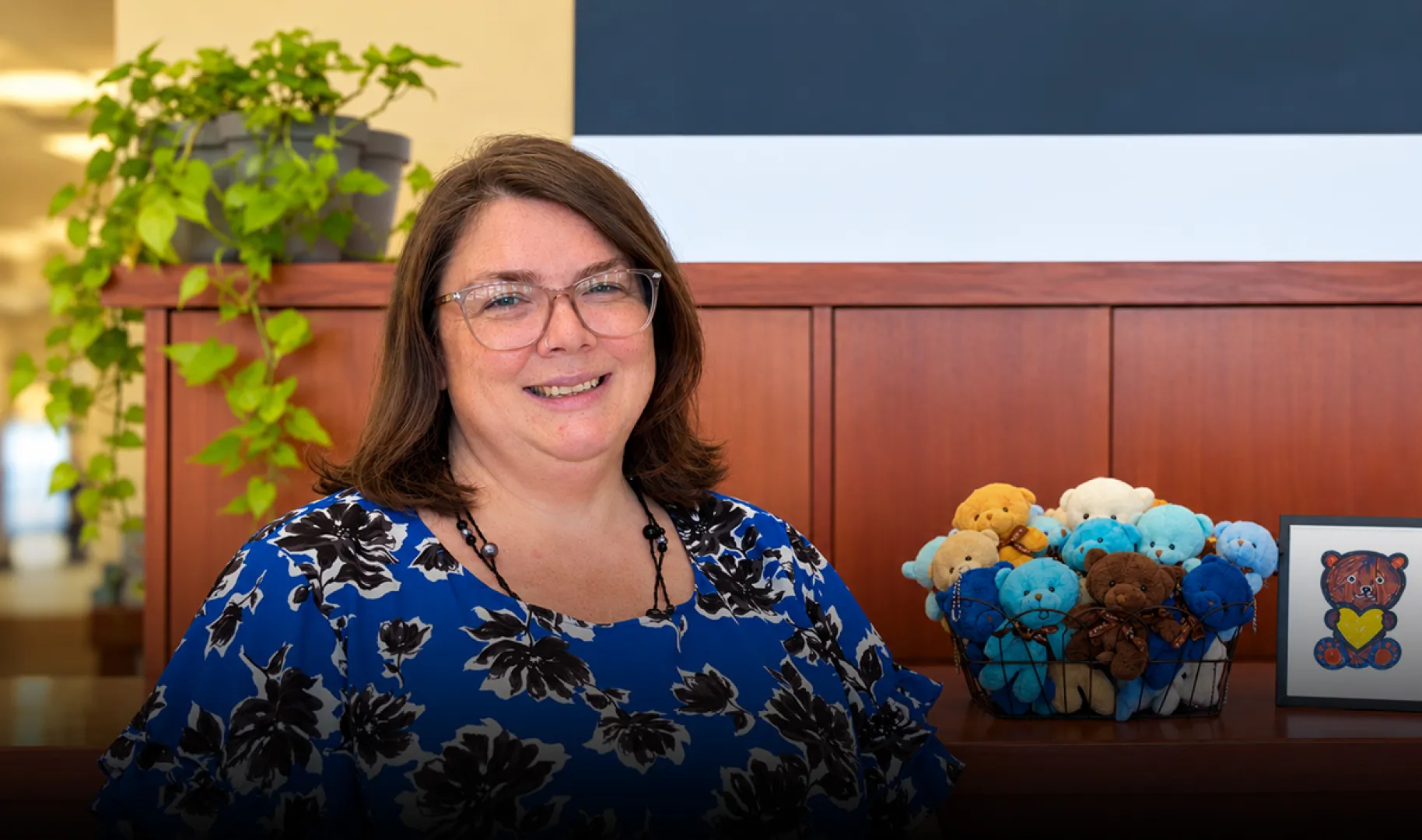
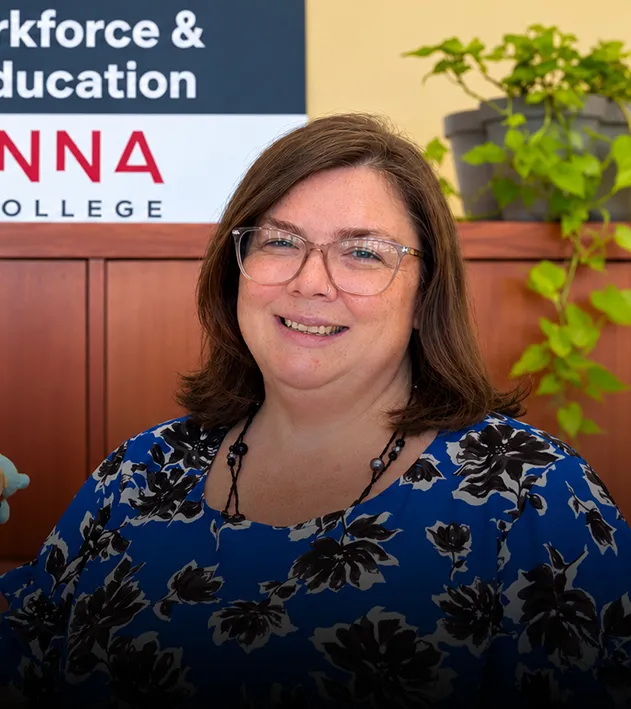

From where Joy Ferguson sits, you can’t help but see the light.
It shines in rectangles through the glass façade of the Workforce and Technology Center at Germanna Community College, where students come to learn a trade or take trigonometry.
Every morning, Ferguson takes her place in the lobby, behind a gleaming wood desk that overlooks the campus courtyard, and sets up a whiteboard—her Sign of Happiness. Each day is an occasion of some sort: The first day of fall or National I Love You Day or Smithsonian Museum Day.
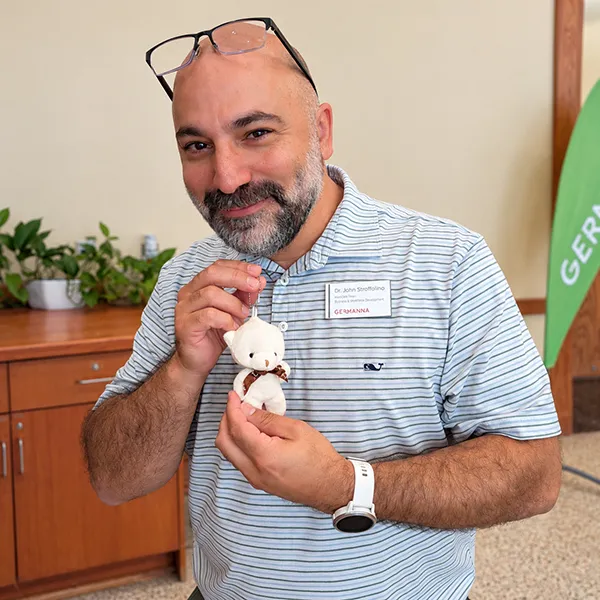
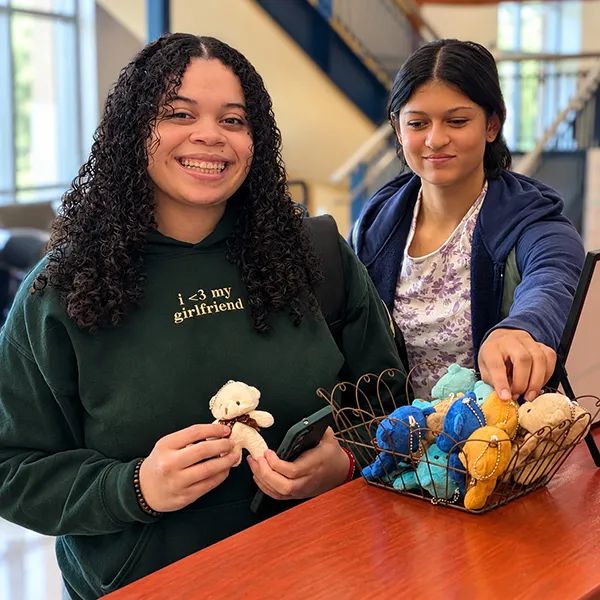
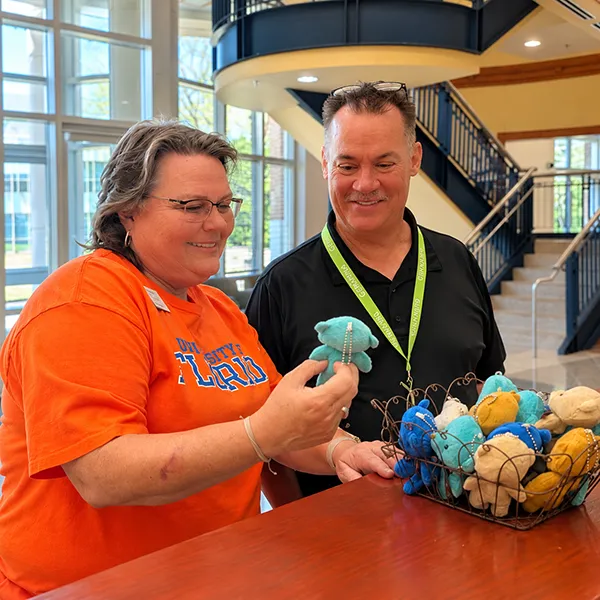
This day—Wednesday, October 14—is Bring Your Teddy Bear to School Day, and she has arranged more than two dozen tiny teddy bears in shades of blue and brown in a bowl for the taking.
Teddy bears are known psychologically to provide both children and adults with emotional security and stress relief, the sign announces.
Years ago, in her first role as a training support coordinator at Germanna, Ferguson sat at this desk. Later, she took a different job, one that helped students pay for college through scholarships and emergency funds but left her with fewer opportunities to interact with them. She knew their struggles. Not enough money for that textbook. Groceries running precariously low. Choosing between paying rent and fixing the car that would get them to class, so they could earn a degree and make a better life for themselves and their families.
Ferguson always told herself that if she won the lottery, she'd return to this lobby, this desk, this seat. She'd listen to students' stories and become their secret fairy godmother, infusing their lives with little glimmers of light: a gift card for diapers for their kid or pizza for the family. A textbook. A stocked fridge.
“Little stuff,” she said, “something they normally wouldn’t be able to afford. Something that would take the burden off that student even for a day.”
Ferguson likes to say she half-won the lottery. She did not become a millionaire. Nothing like that.
A couple of months ago, Germanna needed a workforce enrollment specialist to greet students as they entered the Workforce Technology Center. The desk had sat empty for some time.
Now, Ferguson would return to it, bringing her little signs and little surprises—stubborn, deliberate acts of joy from a woman who knows how easily the dark can overtake the light.
The Nature of Joy
When Joy Ferguson’s parents were expecting their first child, they chose a name that reflected how they felt about the baby on the way. It also honored both their mothers, Joyce and Mary.
They called her Joy Marie.
A name like Joy came with a certain unspoken expectation. Crying seemed wholly out of character.
“I had ADHD that was undiagnosed. I didn’t do my homework, but I did really well on tests, and I sat still.”
One teacher called her Joi de Vivre—joy of life.
As far back as Ferguson can remember, she wanted to take care of people. To make them happy.
Then, when she was 14, a great sorrow: her father died.
“When you’re 14, you don’t know how to grieve, how to deal with something like losing your dad.”
But the sadness and loss were there, taking up space.
After high school, Ferguson attended SUNY Ulster, a community college near her home in upstate New York. Financial aid made it possible. She dreamed of becoming a second-grade teacher like the one she’d had, “the most amazing woman ever.”
At SUNY Ulster, she was a work-study student in the Dean of Students Office. “That’s where I got my bug.” Ferguson became Student Government President and the student representative for the Board of Trustees.
Two years later, she landed a job in the school’s admissions office. Later, she would move to Virginia, where she got a job working with adult learners at George Mason University.
She continued showing up for students and doing her best. But in her own life, the light was beginning to fade.
A Mile Toward Freedom
Ferguson had been married for eight and a half years, together for 10, when she decided, for the final time, to leave. She had spent most of her life believing the best in people. So when control and cruelty edged into her marriage, she did not recognize them for what they were at first. How do you call something abuse when the concept is completely foreign to you?
She had thought about leaving. She had planned to leave. But it wasn't until she connected with an attorney through a free consultation offered by the Women's Center in Vienna that she finally did.
Ferguson shared some of what was happening in her marriage. The attorney asked what was stopping her from leaving.
Ferguson told her.
“She literally said, ‘Sweetheart, you can leave whenever you want.’”
It was a Wednesday. By Saturday morning, at 6 a.m., Ferguson was gone.
“I slid my clothes on quickly, got my cat and my purse, and snuck out.”
About a mile down the road, she reached a stop sign. She stopped and called her mother, who had been waiting all night for word that she'd made it out.
“Mommy, I got away. I'm fine. I did it,” Ferguson told her.
Then she began to sob.
“Joy, this is a good thing. Why are you crying?” her mother asked.
“Because I'm just so happy.”
“It was this wonderfully amazing, scary, overwhelming, insane feeling of just bliss,” Ferguson said. “I never use the word ‘joy.’”
A Place to Begin Again
She moved in with a friend in Fredericksburg and spent the next year looking for jobs closer to her new home.
“I didn’t even apply to any. I just kept watching. A job at Germanna popped up. It was in Workforce. It looked perfect. It was the first job I applied to, and I got it.”
At Germanna, she found her way back to the work she loved: helping students figure things out and find their footing.
“I know from personal experience that this process isn’t intuitive at any college or university. It’s not something someone who has never done it before would know. You don’t know what you don’t know. You don’t know what questions to ask. I tried to make them a little less stressed, a little less anxious. When you get upset, when something doesn’t work right, when you can’t get through somewhere, that’s when students give up. I don’t want that to happen.”
Ferguson heard so many of their stories, the often unique struggles of community college students. Young adults paying their own way. Those who hadn’t been in classrooms for decades but wanted something better. Those balancing families and jobs and school.
While she helped students navigate college, she was also rebuilding her own life. She found a new relationship with a 911 operator who made her feel safe. He is the kind of person who makes stir-fry and picks out the vegetables she doesn’t like while making her plate. Who drives her to yard sales and waits in the car with the dog while she hunts for treasures. Who proposes marriage on a merry-go-round at National Harbor.
In September, she had another chance to do what she had always felt most called to do: listen, troubleshoot, help students find their way forward. Remind them that someone sees them.
Small Acts of Joy
The last decade has brought a kind of beauty to Ferguson’s life she did not always think was possible. But it has not been without sadness. A year and a half ago, she lost her stepfather.
“He was my dad twice as long as my real dad. When I lost him, it was like losing my dad again. Things are better, but it feels like sometimes things have to get worse before they get better,” she said.
“Most of my life I have battled with depression. I don’t want anyone to feel like I do. I want people to feel like they’re loved and they’re enough. That they are accepted for who they are.”
She looks for little ways to make sure people feel seen.
“On National Play-Doh Day, I handed out Play-Doh. People just went crazy. It wasn’t just students. It was staff.”
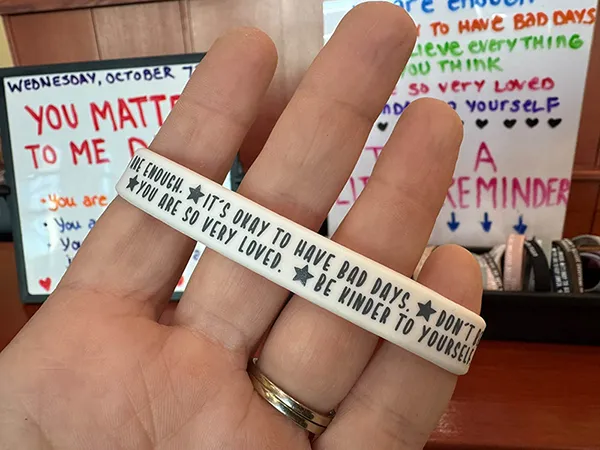
On October 7, National You Matter to Me Day, she handed out bracelets stamped with little mantras: You are enough. It’s OK to have bad days. Don’t believe everything you think. You are so very loved.
One student who took a bracelet lingered. She told Ferguson she had a lot going on in her life. She told her how much these reminders meant to her.
“If I can just help one person—if it’s one of my colleagues, a staff member, here, a student, a community member who comes through—if I can help one person feel a little better about themselves, let them know they’re wanted in this world and here at Germanna. This is a family. We’re here to take care of each other. Stuff happens and it’s hard to get out of. Seeing somebody get excited or happy over this—it just makes me happy, even if it’s just a moment. You forget about all the bad stuff and everything that’s going on in the world and your life. It just gives you hope again.”
And it is infectious.
Because her signs of happiness have become so popular, and because she has not yet won the lottery, Ferguson created an Amazon wishlist so that people can contribute. There are colorful leis for Lei Day, anti-bullying pens for National Stop Bullying Day. Little crocheted hearts—“pocket hugs”—for Let’s Hug Day.
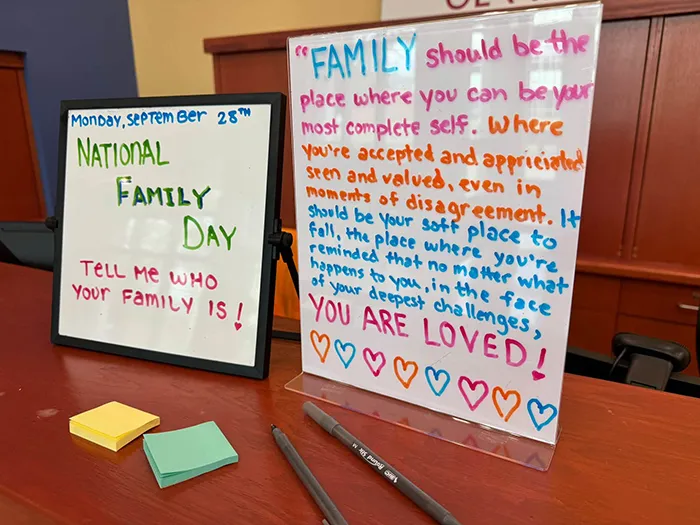
There are conversation starters, too, like maps for Ancestry Day where students and faculty and staff can show where they are from. Or sticky notes for National Family Day where students can write who their family is.
“Everybody is helping,” Ferguson said. Bosses and colleagues and family and friends.
“When a person walks through these doors or walks around that corner to have a very welcoming environment that changes every day—that’s important,” said Tina Lance, Germanna’s Dean of Professional and Technical Studies and Workforce Development. “Previously, we had an empty desk. When a person came in, it wasn’t welcoming. It was just empty. Now, every day, there is something different you get to engage in, think about, just smile. It starts conversations you would not even normally have.”
Lance has stepped out from her office into the lobby just to see what Ferguson has planned for today. She takes a tiny teddy bear, looks at it, and hugs it to her chest.
“A lot of people hide what they’re feeling,” Ferguson says. “Some of my darkest, darkest, darkest days, I’ve been out in public and working and nobody would know that I don’t want to be here—in life. If I can help somebody not feel like that—I would rather have the hurt than somebody else. I don’t want anyone to ever feel how I feel sometimes.”
Others stop by. A student asks if she can take a teddy bear. Two students sift through the basket and pick out their favorites. A math professor and an associate dean stop to see what Ferguson has planned.
The light is always changing. It shifts. It dims and sharpens, and sometimes it illuminates everything.